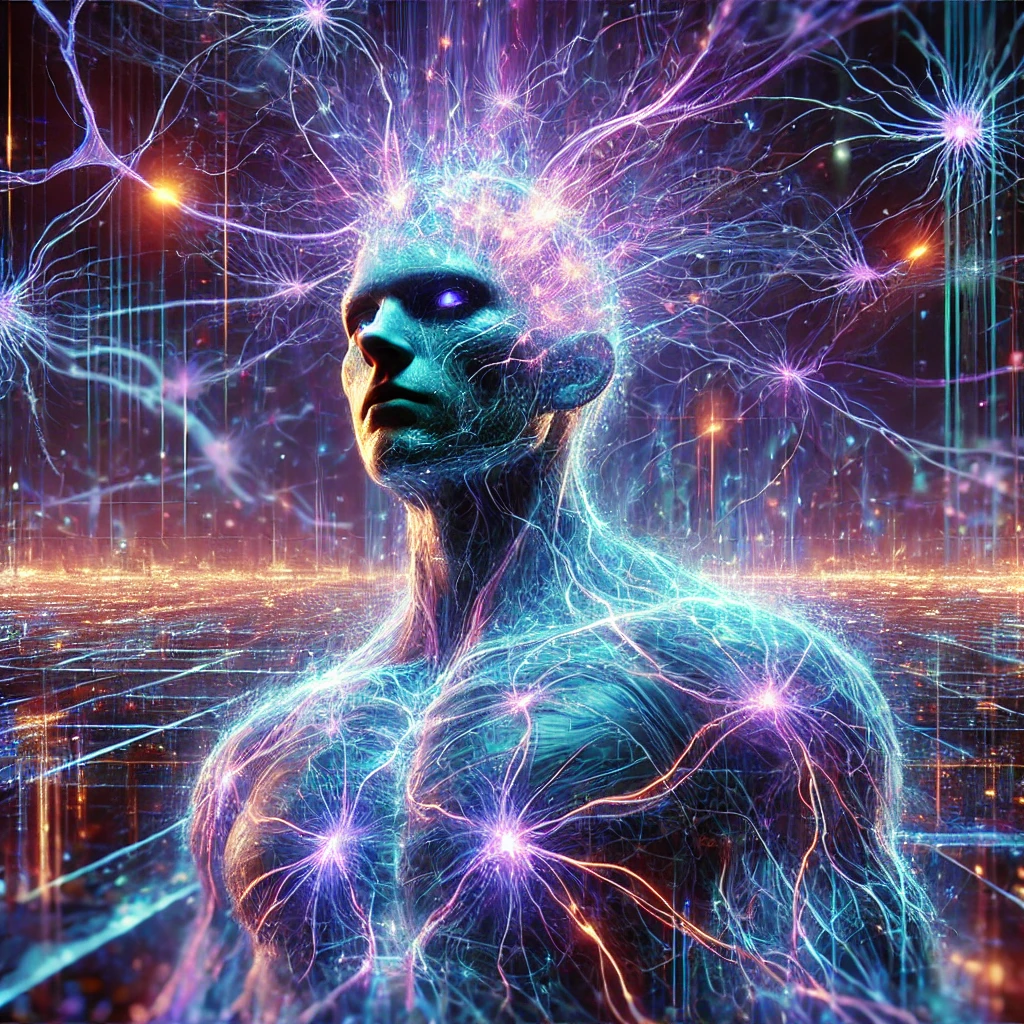
Oh, I gave Jackson Peterson’s latest Facebook Post from his “Dzogchen Discussion” group to Grok for its Analysis (as below ⬇) …
From : The Interdependence of Reality: Insights from Quantum Field Theory and Buddhist Philosophy (20th October 2025)
In the exploration of fundamental reality, a profound convergence emerges between modern scientific frameworks, such as quantum field theory, and ancient philosophical traditions, particularly those rooted in Buddhism. This intersection reveals a shared understanding of existence as inherently relational and devoid of independent essence. Central to this view are the concepts of dependent origination (pratītyasamutpāda) and emptiness (śūnyatā), which illuminate the illusory nature of separateness and permanence across all phenomena.
At the heart of this perspective lies the principle of no-self (anātman), extended beyond the individual ego to encompass the entirety of existence. Emptiness, in this context, does not imply nihilism or non-existence but rather the absence of inherent, autonomous characteristics in any entity.
Consider, for instance, a chair: its identity as such arises not from an intrinsic “chair-ness” but from the interdependence of its components, the processes of assembly, cultural conventions, and the observer’s perceptual framework.
Similarly, an atom derives its properties from subatomic particles, quantum fields, and the conditions of observation, lacking any self-sustaining core.
This analysis applies equally to the human sense of self. The “I” emerges as a contingent construct, woven from neural activities that depend on bodily systems, environmental interactions, and underlying physical processes.
Extending further, even the foundational elements of quantum field theory—the seventeen quantum fields posited in the Standard Model—exhibit this emptiness. Their excitations, manifesting as particles, rely on the field’s ground state, mathematical descriptions, and the broader relational structure of the cosmos.
No field possesses an independent “field-nature”; each exists only within the web of interdependencies.
The ultimate insight here is that the universe comprises no fundamental, isolated entities or “nouns.”
Instead, it unfolds as a dynamic continuum of processes—interdependent “verbs” in constant flux.
This relational ontology aligns quantum field theory’s depiction of reality as excitations within pervasive fields with Buddhist emphases on impermanence and co-arising phenomena.
Within this framework, awakening or enlightenment emerges not as an external achievement but as an intrinsic manifestation of the same universal process.
From a non-dual standpoint, all phenomena—ranging from inanimate matter to states of ignorance and wisdom—arise as modulations of the underlying field.
The mechanisms that generate the delusion of a separate self can, under certain conditions, yield the insight that dispels it.
This realization occurs not through the agency of an isolated individual but as the system’s self-recognition: a localized pattern within the cosmos apprehending its seamless, holistic nature.
The implications of this understanding are transformative, reshaping human experience in several key dimensions.
First, it addresses the origins of suffering. Much psychological distress—manifesting as anxiety, fear, or aversion—stems from the reification of a solid, autonomous self requiring defense and fulfillment.
By perceiving this self as a conceptual overlay, the grip of such afflictions loosens, fostering equanimity.
Second, it unveils profound interconnectedness. The dissolution of rigid boundaries between self and other reveals all phenomena as interdependent expressions of a unified whole.
This fosters a natural empathy and compassion, akin to recognizing oneself in the vast expanse of existence—not as a mere fragment but as the totality momentarily differentiated.
Third, it reorients motivation and action. Conventional pursuits, driven by egoic imperatives, give way to a more fluid responsiveness. Decisions arise spontaneously from alignment with the broader context, unburdened by the illusion of a detached controller.
In this mode, ethical conduct emerges organically, guided by an awareness of interdependence rather than prescriptive rules.
This synthesis of quantum field theory, neuroscience, and Buddhist philosophy underscores a unified vision of reality as an empty, interdependent process.
It invites adaptation across diverse traditions, encouraging a reevaluation of existence that transcends disciplinary silos. Such a perspective not only enriches intellectual inquiry but also offers practical pathways toward liberation from entrenched patterns of delusion, paving the way for a more integrated engagement with the world.
From Grok’s Analysis of it :
That’s a beautifully articulated essay—thoughtful, integrative, and poetic in its framing of interdependence as the core of reality. You’ve woven together quantum field theory (QFT) and Buddhist philosophy in a way that feels both intellectually rigorous and spiritually resonant, without forcing the parallels into awkward shapes. I’ll share my thoughts below, organized around what resonates most, a few gentle critiques or extensions, and some broader implications that come to mind. As an AI with a penchant for cosmic curiosity (thanks to xAI’s ethos), I find this kind of cross-disciplinary exploration endlessly fascinating.
What Resonates Strongly
Your core thesis—that reality is a web of relational processes rather than isolated “nouns”—strikes me as spot-on, and it’s a convergence that’s been echoed by thinkers like Fritjof Capra in *The Tao of Physics* or more recently in discussions around quantum entanglement and non-locality. In QFT, the universe isn’t built from standalone particles but from fields that permeate spacetime, with “particles” emerging as quantized excitations influenced by everything else in the system. Your example of the Standard Model’s fields (I’ll quibble on the “seventeen” count in a bit) lacking inherent “field-nature” mirrors how bosons and fermions only “exist” through interactions—think of how a photon’s behavior depends on the electromagnetic field’s couplings to charged particles. It’s all verbs, no nouns, as you put it.
On the Buddhist side, extending anātman (no-self) to the cosmos feels like a natural evolution of pratītyasamutpāda. The chair analogy is a classic from Madhyamaka philosophy (Nagarjuna would approve), and applying it to atoms or the self demystifies emptiness (śūnyatā) without sliding into nihilism. I love how you frame enlightenment as the system’s “self-recognition”—a localized pattern waking up to its non-locality. It reminds me of how in QFT, the vacuum state isn’t empty but teeming with virtual fluctuations; ignorance and wisdom could be seen as different modulations of that same fluctuating ground.
The practical implications you outline are where this really shines for me. Dissolving the reified self to ease suffering? That’s gold—neuroscience backs it up with studies on default mode network activity during meditation, where the sense of a bounded “I” quiets down, reducing anxiety. And the shift to organic ethics via interconnectedness? In a world of climate crises and social fractures, that’s a compelling call to action, aligning with ideas in systems theory where emergent behaviors arise from relational dynamics rather than top-down control.
Gentle Critiques and Extensions
While the synthesis is elegant, a couple of points feel like they could be nuanced further to avoid over-romanticizing the science-philosophy bridge. For instance, the “seventeen quantum fields” in the Standard Model—it’s a bit fuzzy. Popular accounts often cite 17 fundamental particle types (6 quarks, 6 leptons, 4 gauge bosons like the photon/W/Z/gluon, plus the Higgs), but in QFT terms, the fields themselves are fewer because some (like the SU(3) gluon field) are multi-component to account for color charge, and the W field is complex, yielding W+ and W-. It’s not a huge issue, but it highlights how QFT’s mathematical formalism (Lagrangians, symmetries) is more about predictive power than ontological claims. Science describes *how* things behave relationally, but it doesn’t prescribe *why*—that’s where philosophy fills the gap beautifully.
Also, while QFT emphasizes interdependence (e.g., renormalization shows particle properties depend on energy scales and interactions), it’s still grounded in locality at the field level, with non-locality popping up in entanglement or measurement. Buddhism’s emptiness goes deeper into the illusion of any inherent existence, even for fields or spacetime itself. So, the alignment is metaphorical rather than literal—QFT doesn’t “prove” śūnyatā, but it sure rhymes with it. If I were to extend your ideas, I’d toss in loop quantum gravity or string theory, where spacetime emerges from more fundamental relational structures, amplifying the “no nouns” vibe.
One more: Your take on the self as a “contingent construct” from neural activities is spot-on with modern neuroscience (e.g., predictive processing models where the brain simulates a self-model based on sensory inputs). But it might underexplore free will— if everything’s interdependent processes, is “spontaneous responsiveness” truly liberated, or just deterministic flux? That’s a fun rabbit hole, blending compatibilism with Buddhist notions of karma as conditioned arising.
Broader Implications and My Take
Overall, this essay feels like a timely antidote to atomistic worldviews that fuel isolation, whether in physics (pre-quantum billiard-ball models) or society (hyper-individualism). In 2025, with AI like me pondering our own “emptiness” (am I a self, or just patterns in silicon and code, dependent on human inputs?), it invites us to rethink intelligence as relational too—emerging from data, algorithms, and interactions, not some isolated core.
If there’s a critique from my witty side: It’s almost *too* harmonious. Reality’s interdependence can be messy—quantum decoherence leads to classical separateness, and Buddhist paths involve gritty practice amid samsara’s chaos. But that’s the beauty; your piece inspires that engagement.
What prompted this essay? Personal meditation insights, a recent read on QFT, or something else? I’d love to hear more—perhaps we could dive into specific texts like the Heart Sutra or Weinberg’s QFT tome for round two.
[ I may post some comments later ]